
 After a brief introduction on the role of the Health Foundation of which she is Chief Executive, see https://www.health.org.uk for further information, Dame Jennifer shared information from an IPSOS survey in August 2022 about what makes people proud to be British. Allowed three choices, the NHS was way ahead at 55%, ahead of our history (33%) and the Royal family at 28%. The NHS matters to us.
Where we are now with regard to the NHS and social care? There has been a decade of underinvestment – especially in non-hospital care and the pandemic had a major impact. There are significant labour shortages, a financial squeeze, all leading to quality and performance issues. Jennifer noted that after the significant reforms of 2012 there was not a huge appetite for more. She felt that the guiding currents for reform between 1990 and 2008, competition, choice and investment were gone and that since then the focus has been collaboration and integration, aided by data and some structural change. Investment has been below average
Ahead lie serious challenges; economic and fiscal; demographic – an ageing population with greater need and shortage of working age people; greater demand with a morbidity wave to 2040/50, personalised prevention, demand-inducing technology, inequality; climate change, both the health impact and the need to achieve net zero; polarisation and shifting grounds about public trust and notions of collectivity. At the same time technology is coming thick and fast and we need to evaluate as well as harness and afford these developments.
There are assets to build on; a single payer and systems of cost control; cradle to grave data; public and political support and trust; connection with universities and strong science base and the ability for national strategic co-ordination. The latter will be important when it comes to deciding what new technology to invest in, in particular allowing a focus on public objectives for the investment, such as sustaining the NHS, not just private/commercial objectives.
Health spending has been increasing as a share of government spending. Whilst in the 1950’s over 20% share of public spending went on defence with under 10% on health, now UK health spending as a part of managed expenditure is around 20% and defence 5%. During that period growth in education expenditure, which started at similar levels to health has grown at a much slower rate.
Health expenditure as share of public service spending is nearer 30% now and as a part of and the DHSC as a share of day to day departmental spending is around 45% (Source; The past and future of UK health spending, IFS 2024). This trend can probably not continue.
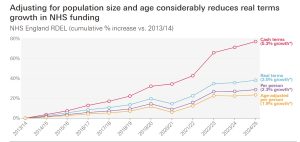 This does not mean that we have adequate NHS funding. Similar growth has been seen in Europe, but our lower GDP pp means that we spend 21% less per capita than France and 39% less than Germany. The growth in real terms funding for the NHS since 2013/14 when taking into account population size and age is shown in the graph below.
The UK also spends significantly less on capital in health care than other comparable OECD countries as a % of GDP.
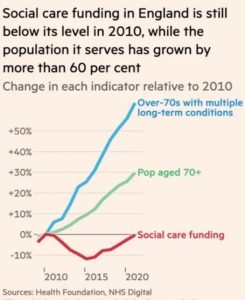
The historic average of growth in NHS expenditure from 1949/50 to 2019/20 is 3.6% although there has been significant variation between parliaments and since 2010 the growth has been below this average. Predicted GDP growth alone will not cover this average rate of increase. Social care funding has also need kept up with need; it is still below its level in 2010.
Looking Forward
Sharing work done by the REAL team at The Health Foundation, Jennifer highlighted the following challenges for the medium term:-
- Life expectancy for people living in England is expected to increase further over the next 20 years, but the average age at which people are expected to be living with major illness is projected to remain constant at 70 years.
- The amount of time people are projected to live with major illness is expected to increase from 11.2 years in 2019 to 12.6 years in 2040
- 80% of the total rise in population morbidity to 2040 will be due to the increase in the number of older people, rather than an expansion of morbidity.
- Almost 1 in 5 of the population (9.1m) are projected to be living with major illness by then, an increase of more than a third.
- The share of the population living with major illness (37%) will grow nine times faster than the working-age population (4%) in this period. There will be no alternative but to foot an increasing bill
In addition to investment and reform architecture, Jennifer considered that the focus needs to be on effective use of workforce and technology, and developing the role of patients in managing their own health. Digital and AI technology has a big role here, as well as in wider population health management as well as service delivery.
The NHS will continue developing the NHS App – as of December 2023 there were 33.5m users (80% of adults) registered in England. Content and services available on the app and online will be tailored to a person’s needs and choices, making it easy to self-serve and provide choice in the ways they interact with the NHS.
There are also plans to ensure that at least 80% of social care providers have a digitised care record in place that can be connected to a shared care record, and they will reinforce the use of the NHS number universally across adult social care to support this.
A key issue will be longer term policies. Laying the track just as the train arrives, i.e. short-term crisis-led decision making will not be effective. Talking the night before the 2024 General Election Jennifer considered what the manifestos said about health policy. Quoting OECD, Jennifer shared four options for NHS policy makers:
- Raise additional tax revenue
- Shift public spending from other areas of public spending
- Reduce coverage / shift mix of public, OOP and VHI payment
- Reduce spending pressures by improving population health and system efficiency
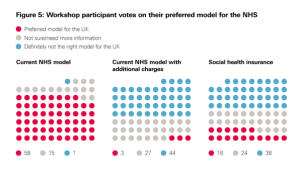 The Health Foundation has done some work on what the public want moving forward. The current funding model remains the favourite, as this graph depicts.
A Ipsos survey commissioned by The Health Foundation, showed that around half of respondents would support increasing taxes to maintain the current level of NHS care.
A Ipsos survey commissioned by The Health Foundation, showed that around half of respondents would support increasing taxes to maintain the current level of NHS care.
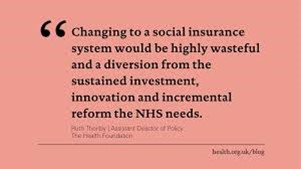 Having done some comparative studies at The Health Foundation, there are questions about whether social insurance models – such as in Germany – are better at raising additional funding. Jennifer quoted one of her staff, Ruth Thorlby (also a Harkness Fellow), about the costs of such change (see box).
Health Foundation commissioned analysis by the Organisation of Economic Cooperation and Development showed that no broad type of health care system internationally performs systematically better than another in improving the population health status in a cost-effective manner. The main message is stick to what you’ve got and make it work better.
In conclusion, Jennifer felt that the new government would need to recognise that the NHS has huge assets as well as huge challenges and that the model is sound, but needs sensible investment even though the fiscal context is very tight. She recognises there needs to be a short-term focus on must-dos, but there must also be a focus on medium term transformation including investing in and trialling: labour saving technological improvements; models of care which invest in out of hospital care and shift more care into the community safely; as well as a greater role for patients in self management. Above all, innovations are needed at speed less palatable options await.
Dame Jennifer took questions from the audience.
Further information about the work of The Health Foundation can be found https://www.health.org.uk.